Deformation
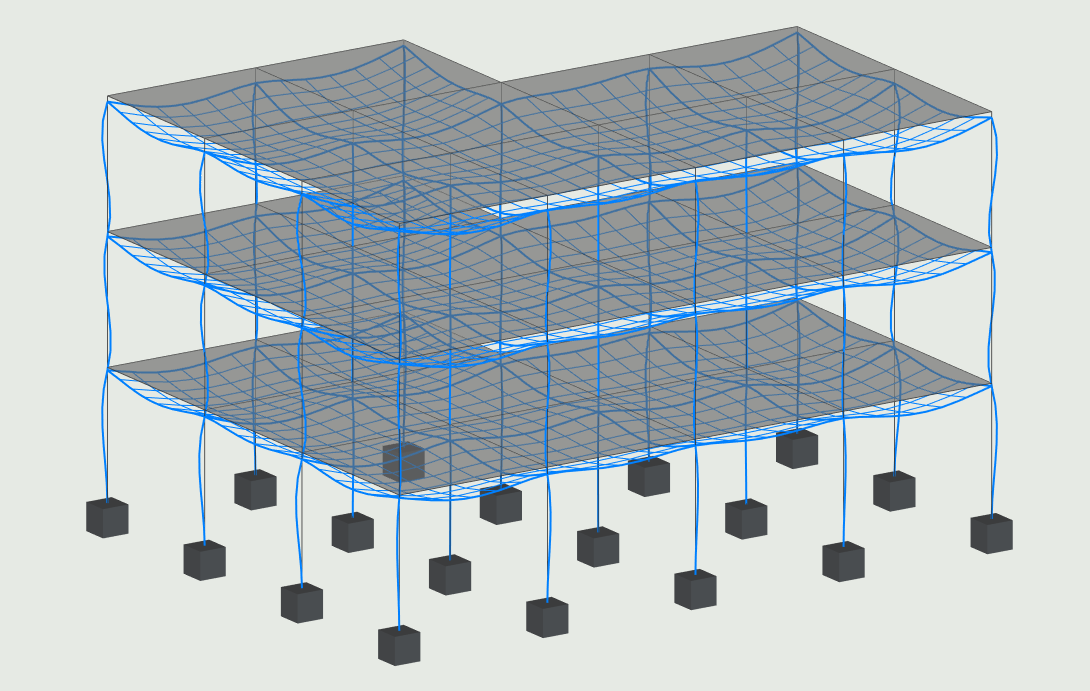
This tab is used to visualise the deformed shape of the model. You can visualise the total deformation, or the deformation in each of the three global directions. For frame elements, the deformed shape is computed exactly from the governing differential equation with Dirichlet boundary conditions. It is not obtained by simple interpolation of nodal displacements.
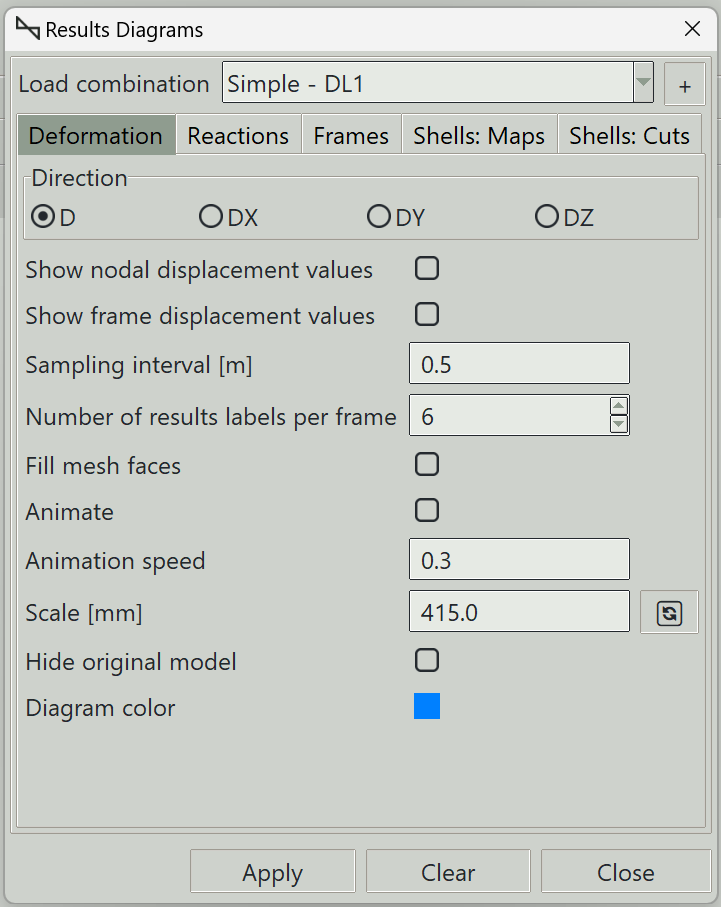
1. Load combination
The name of the load combination to display results for.
2. Direction
You can visualise the total deformation, or the deformation in each of the three global directions:
- D: Total deformation
- DX: Deformation in the global x-direction
- DY: Deformation in the global y-direction
- DZ: Deformation in the global z-direction
3. Show nodal displacement values
Whether to display displacement values at nodes.
4. Show frame displacement values
Whether to display displacement values along frame elements.
5. Sampling interval
Defines the spacing of sampling points along frames where deflections are evaluated. Smaller values produce smoother results.
6. Number of results labels per frame
Specifies how many result labels are displayed along each frame.
6.1 Fill mesh faces
Controls whether deformed shell elements are displayed as filled surfaces or wireframe.
7. Animate
Enables animation of the deformed shape.
7.1 Animation speed
Controls the speed of the animation. Higher values produce faster motion.
8. Scale
Controls the amplification factor of the displayed deformation.
9. Reset button
Use this button to reset the scale.
10. Hide original model
Hides the undeformed model when displaying the deformed shape.
11. Diagram color
Sets the color used to display the deformed shape.
12. Apply button
Displays the deformed shape in the specified direction. If some elements are selected, results are displayed only for those elements.
13. Clear button
Clears all result graphics from the model view.
14. Close button
Closes the window and clears all result graphics.