Frame Thermal Load Definition
This tab is used to define thermal loads that can be assigned to frames. The left pane displays a list of frame thermal loads available in the model, while the right pane shows the parameters of the selected load. The same area is also used to input parameters when creating a new frame thermal load.
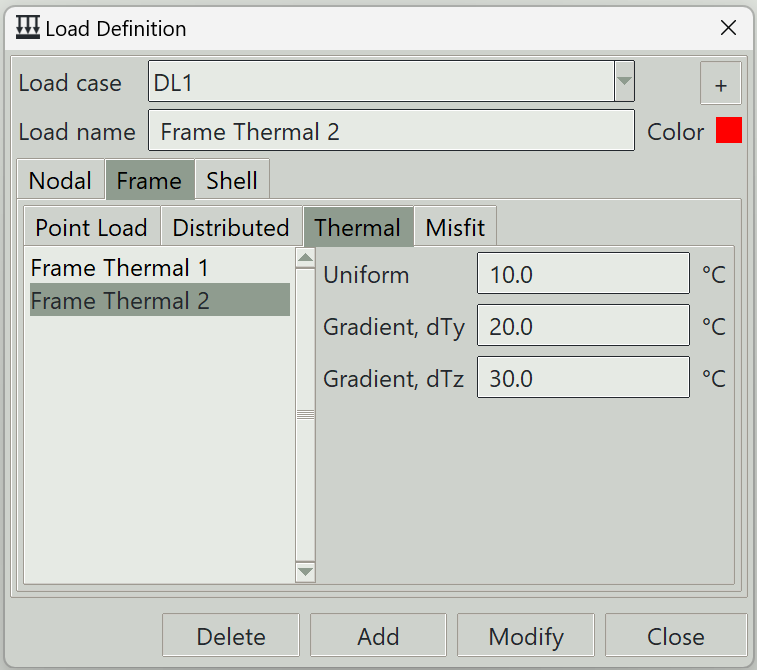
1. Load case
Select the load case under which this load is defined.
2. + button
Opens the load case definition window so that you can add a new load case.
3. Load name
A unique name for the load. It can be left blank, in which case the program will generate one automatically.
4. Color
The color assigned to this load for visualization purposes.
5. Uniform
Represents a uniform temperature change of the frame relative to its surroundings. A positive value indicates that the frame is at a higher temperature than its surroundings, while a negative value indicates it is cooler.
6. Gradient, dTy
Represents the temperature difference across the section in the local y-direction. It is defined as the temperature at the positive y face minus the temperature at the negative y face. A positive value means the side in the positive y-direction is hotter than the side in the negative y-direction.
7. Gradient, dTz
Represents the temperature difference across the section in the local z-direction. It is defined as the temperature at the positive z face minus the temperature at the negative z face. A positive value means the side in the positive z-direction is hotter than the side in the negative z-direction.
8. Delete button
Removes the selected load from the model.
9. Add button
Creates a new load using the specified parameters.
10. Modify button
Updates the parameters of the selected load.
11. Close button
Closes the window.